Added thought from Stacy, who took notes Thursday and would like to add the following email she received from Liz on Oct. 6, regarding this quote: “Dr. Jane chose, every single day, to make the world better. I hope, in her honor, we all choose the same.” Now, back to last week’s meeting:
Kevin noted, “at the risk of offending some of our guests today,” he welcomed all “to the best Rotary Club in the world” which brough cheers. He also added “I’m sure also, like you, your members all arrive on time,” and ready to start the meeting,” and when latecomers arrive, we’ll be sure to welcome them.” Visiting Rotarians included the speaker; guests for the meeting including Larkin Evans, still a guest until she fills out her application, Kevin said. He went on to note that next week’s meeting will be a social at 5 p.m. on Thursday, so we’re not going to have a meeting, at noon at the library. He asked for suggestions for where to have it; Sue has offered to hold the Christmas party at her house; location suggestions included from Stacy, though we just had a social at her house so it might be a bit soon; so her home is available if needed. Kevin thought we might do it at a local restaurant or bar, or whatever … Ralph also noted that since Kevin had a new remodel at his home, (“We’re close” his wife Debbie said, according to Kevin.) The Polio Plus jar went around. We’re this close, Kevin said, holding up two fingers very close together and noting that now polio was now in two countries, Afghanistan and Pakistan. And Oct. 24 is World Polio Day. He’s not sure how we will recognize that day, but “we will do something.” He noted that the small donations jar is also going around.
He said there’s already a donation in there because our new member would like to share some information about her business.
The new member, Karen Senffner, said she was looking for a long time and is happy now to have found a place to practice in – Shoreline Station. To tell about her business: She is a physical therapist, has been one for 34 years, and the particular technique she does is called “zero balancing.” It is centered at the level of bone, and helps relieve the stresses that all of us hold, following something recent like an accident, a fall, surgery, or something carried with us for a long time. She noted that this is not traditional physical therapy; Kevin noted that he and friends have found physical therapy very hard to get following procedures such as like joint replacements, “you have to wait a long time.” She thanked us for taking time to listen to her.
John Evans was asked for an update on our exchange students. He mentioned Suzanne’s tennis buddy Emma Todd, (Suzanne was an exchange student here two years ago), and exchange students Pascal (exchange student from Italy) and Vicki (an exchange student with a San Mateo Rotary Club) were invited to go with Emma’s family to Gilroy to go apple-picking in orchards there (he was happily eating an apple right then from one of those orchards.) He said that besides apples there were pears, avocados and peaches. What was really interesting, he said, was to see the three teenagers having a great time. Vicki and Pascal had met, but had not met Emma, and John said it was like they all were kindred spirits, laughing and singing in the back seat and unaware of the adults in the front seat paying attention to them. He added that recently they had gotten an unexpected face-time call from Caroline from Belgium, an exchange student 10 years ago that many of us remembered. She is now 27 and she was talking about how different her life is now than when she was a teenager. She is now, this week, in her second year of residency; last year she was in an ER residency and this year an OB-GYN residency. For six years. This is all in Brussels. She said, be sure and say hi.
Kevin said, such a wealth to have these relationships with these young people. Just to add to that, another club member added, many years ago, their girls went over to Taiwan for high school, played basketball, and next year the Taiwanese kids came over and played basketball here. But when they arrived, we were all set up to play basketball, but they weren’t basketball kids, they were dancers. Which created a little problem but not much; they went and they danced at all these things. These girls did not speak much English, and our girls didn’t speak any Taiwanese, but they stayed with us for about three days … and they got in the hot tub and they were just chattering away, and we had no idea how they were communicating but they were.
Kevin asked for any other announcements?
Liz said the had one from Drew from the school district for those of us that signed up for Principal for a Day next Tuesday from 9 to 11: He will be sending us confirmations of our assignments; there was some playful bantering between Barb and Kevin about schools; Barb has Cunha and Kevin will go to Farallone View. Barb has a lot of relationships; she successfully pleaded her case, Kevin said.
Kevin said that we have an exciting meeting today, for two reasons: one, we get to learn more about one of our new members, and two, we get to learn about a project that is “really innovative and exciting and will inspire us, hopefully, to do something that we would love to do here, locally.” We might even work with them, who knows.
SUE PRITCHARD - SHOP TALK
First of all, I’d like to ask Sue Pritchard to come up and do your shop talk. We call them “shop talks” because back in the day, you guys – especially the ones who have been around forever, who started the club – remember how it used to be about exchanging business leads and that kind of stuff? We called it a shop talk because it was about your business. We’ve always called it that, even though, really, what it has evolved to is just tell us about yourself, your family, that sort of thing. So, give Sue Pritchard a warm welcome! (applause)
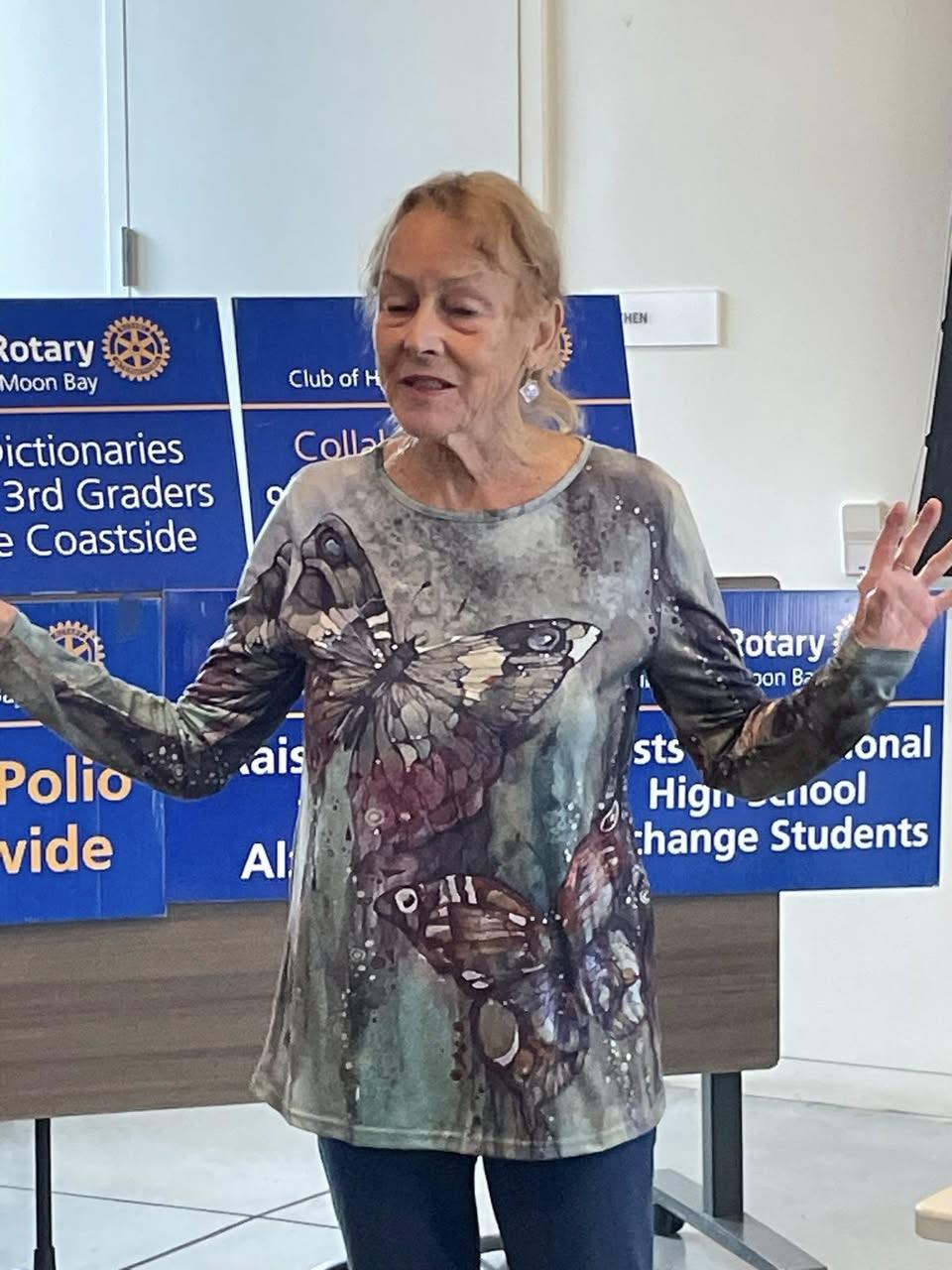
Sue said: I graduated from U.C.L.A. with honors, (“Go Bruins!” Liz yelled,) and then my father died very, very suddenly. He was a founder of Long Beach Memorial Hospital, and my family just fell apart. Then I married somebody who ended up in law school in San Francisco, so there I was; and he become a hippie. So somehow, I survived all of that, which is delightful. I thought – the butterfly goes through an egg, and then a chrysalis, and they finally turn into a compound chrysalis and then an adult butterfly, and then the whole thing starts all over again. It’s a life cycle, and I’ve been through a lot of those. I’ve slept in a barn, I’ve slept in my car, I’ve been on food stamps, I‘ve been to Paris (couldn’t make the name of the location out) first class, and … I’ve painted in Monet’s garden twenty times, when only eight people were there, and it was a delight, an honor. I don’t know how I got there; it wasn’t just about money, it’s just that sometimes the universe puts you where you are supposed to be. I wanted to go to art school when I was a kid, (and) my father said oh no, no, no, you go to UCLA, become a teacher, and then you can support yourself the rest of your life, you won’t need to depend on anyone. And he was so right (laughter) … I was one of seven people that graduated from art school, and they were doing crayons – white crayons -- on white paper, and then maybe watercolor over that, so you could see the resist. It was like kindergarten. And I was like, what’s going on here folks? … and they’ve done it all, it’s like boring, and then they started all over again, and I’m glad I didn’t go through that cycle. I learned how to paint on my own, I learned how to mosaic on my own, and I did that huge mosaic on the Goldworks building, Joe Cotchett hired me to do that, because I won a grant, and we were mosaicking Mac Dutra Park.
And hundreds of people put tiles on Mac Dutra Park. Generations, generations. And then, unfortunately, that became a political mess because some people were sitting inside the wall on paint tables, staring at all the women who went into the bathroom, and so they decided to tear the whole thing down. I was warned by somebody with great power, don’t say a thing. So I didn’t. There was one mosaic that said, the Golden Retriever at the Dog Park. That was saved.
So then I came to Rotary with Patricia (Roma), and --- she did my divorce, one of them – and after it was over, I said, now for something completely different! And I went out to my car and I got my ukelele and I played her a few strums, and now Patricia knows how to play the ukelele, and we hang out and play sometimes, and it’s really fun.
Right now, I’m teaching. Tomorrow morning they’ve asked me again, I founded a ukelele group, at the library here, before Covid, and it’s at night. I live in Montara, and I got tired of driving at night, especially in storms, and I backed out. Well, through all this, they just called me again and said, please come back. So I said okay, so tomorrow at 10 a.m., I’ll be here teaching ukelele. This library now has ukeleles, you can check them out, they have songbooks, you can check those out. We come in here, they’ve got it all set up, they’ve got the music stands, they’ve got the chairs, and we play for an hour. It’s wonderful. Then, on Saturday, I’m teaching landscape painting at Canada Cove, four different sessions. Some of these people will be beginners, some accomplished; one is abstract … I’m not an abstract -- Monet’s garden -- I’m a landscape artist, it’s going to be very interesting. So I’ve spent the last couple weeks getting their egg sets, ordering egg sets, canvases, brushes, little easels to put their work on, for them. She also arranged things to cover up the tables, and we’re all ready to go on Saturday. And it’s a delight to be here.
My father went through the chairs, was a president of Rotary, Long Beach, and Patricia brought me here. Two times perfect; one time it was the piano man, at the piano house (I played (when) young), and he’s incredibly creative. The next time I came, it was the man who was explaining Seton’s growth (the hospital) … except for one thing they did not rip down – my mural. I almost fainted.
So anyway, I’m delighted to be here. I live with three dogs, I play the piano and the guitar, and I’m having a wonderful time. It’s wonderful to be part of your family. (applause)
Kevin said it was delight to have her in the family, but disappointed she did not bring her ukelele (“I wanted to!” she said) or guitar. She clarified that it was a baritone ukelele – there are different kinds of ukeleles – hers is a double-(?) baritone – it tunes like a guitar, (is like) a four-string guitar, and it’s much more beautiful, it has those low notes. She sang a few bars of “They’re Gonna Put Me in the Movies,” and Kevin asked if she would do that for us sometime? (She said, of course, she’d love to!) He also said she must have tons of referrals to Rotary, (because of her career, doing divorces(!)) and with her career, said it was great to get to know her, and thanked her. She noted that “it’s been so fun” because she is self-taught. (Kevin mentioned that he graduated from UCSD (both “beachy” schools) She said she wanted to be an artist but her father said no; and told her to be a teacher because then she’s be in charge of her whole life). She added that it’s been “so fun” because she is self-taught. You can do art every day; like science, math, pictures, it’s all there.
John Evans mentioned that his mother is an alum of UCLA, a smaller school. Liz mentioned that John’s wife Larkin was “the best art teacher we ever had at Half Moon Bay High School,” and Larkin said she is now taking Drawing One at CSM Coastside. Always learning, always growing, Sue said.
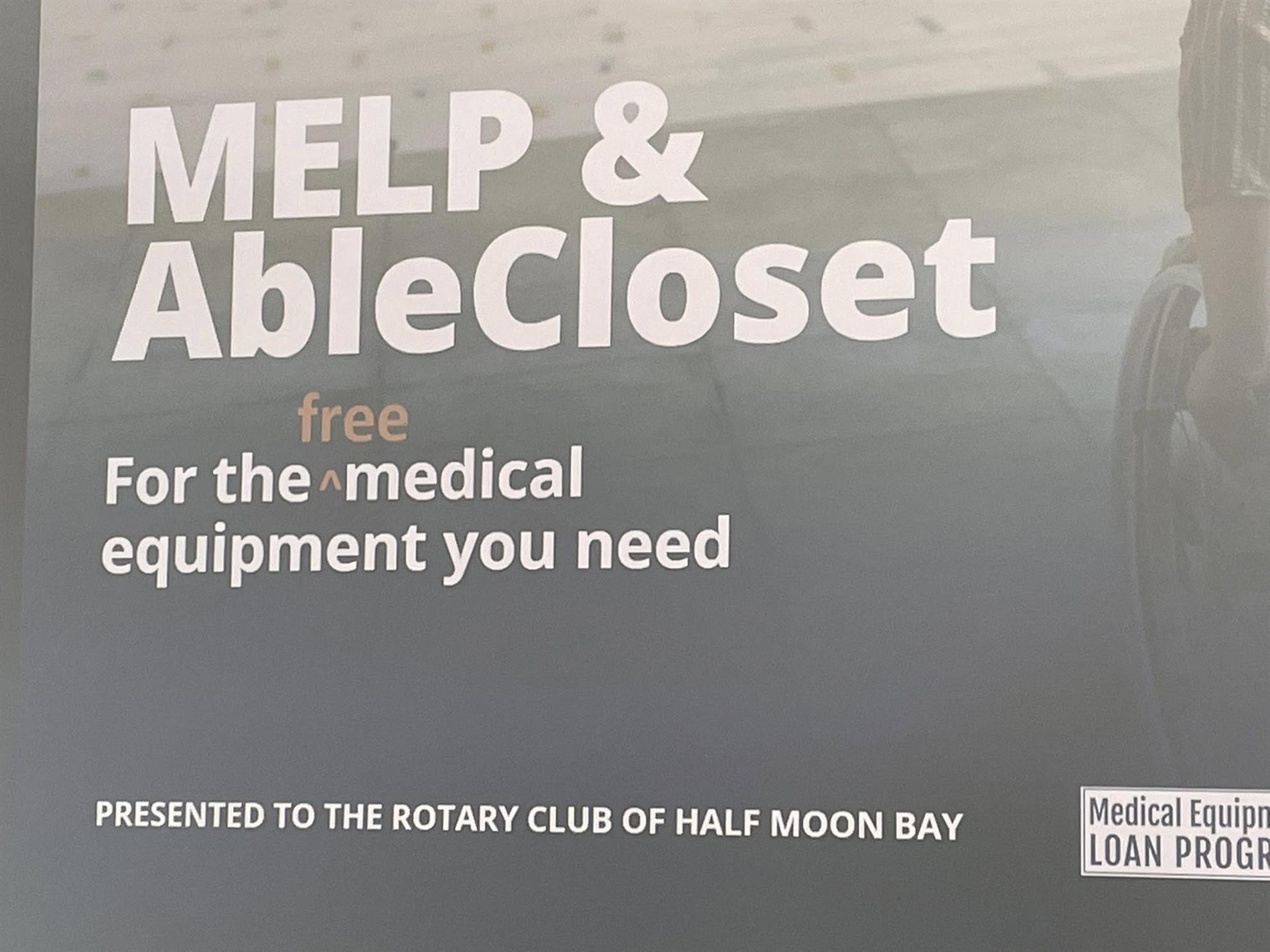
Rotary Club of Belmont/Redwood Shores - Project MELP, or Medical Equipment Loan Program/Able Closet
Kevin said a highlight of the program today was visitors from the Rotary Club of Belmont/Redwood Shores, here to tell about a project that they do: MELP, or Medical Equipment Loan Program/Able Closet. He turned it over to the program.
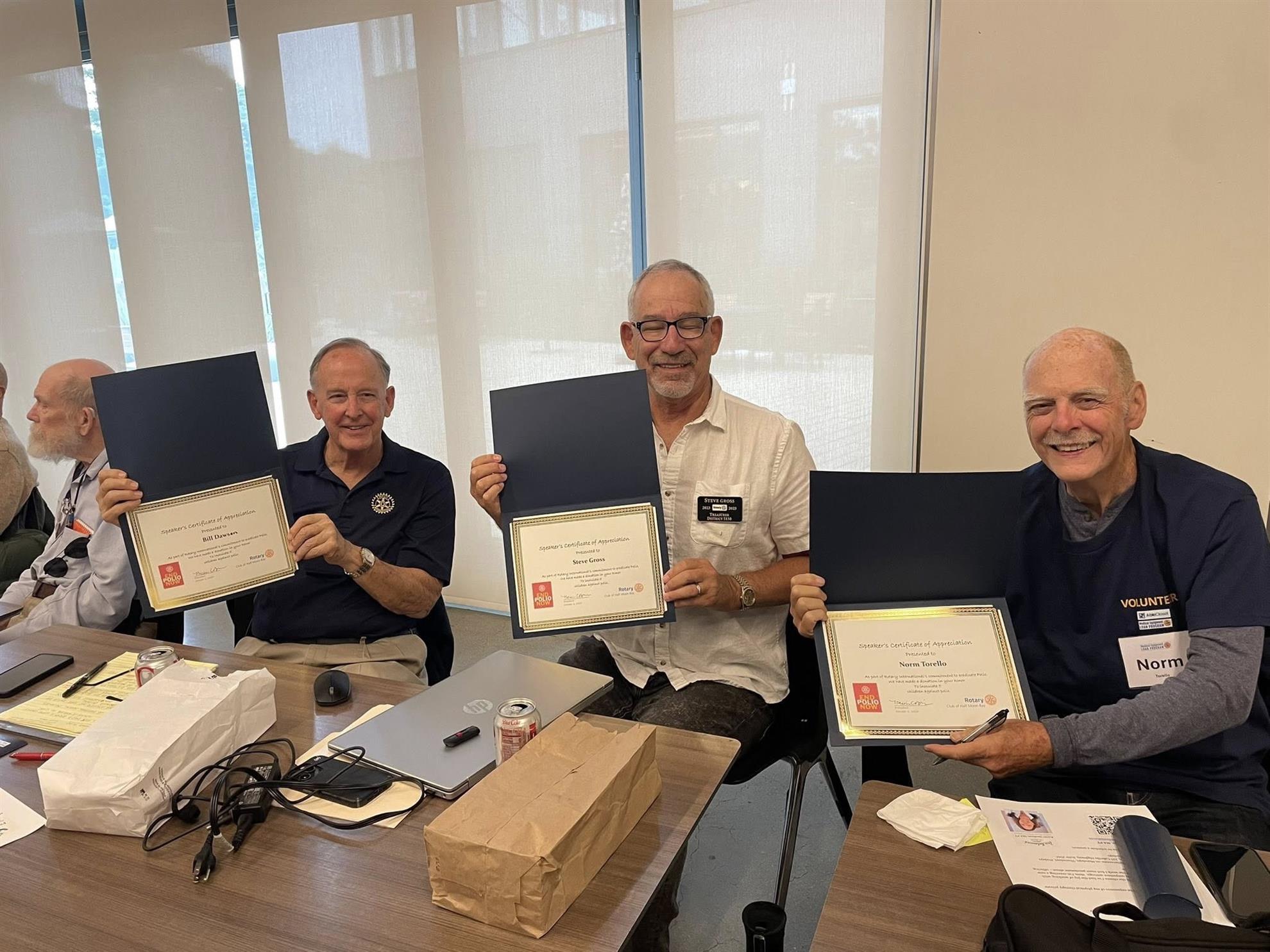
The speakers were introduced, by Steve Gross, from the Belmont/Redwood Shores Rotary club, and also the district treasurer; he works closely with the district governor, “it’s a bummer that she is not here to see this presentation”) and “Liz is our AG (?) as a matter of fact.” He presented Bill Dawson, another longtime member of their club (“without him, there is no MELP Able Closet”), and Norm Carello (not sure about the spelling) who is the club president and joined after they had moved out of Rotary and into their own 501©3. He said that this started in Rotary and was able to move forward because of the resources that Rotary provides.
Steve emphasized that they are all volunteers. They have a couple of consultants, but they’re all volunteers, which he felt was one of the reasons they were able to attract grant money which goes directly to supporting the project, with virtually no overhead. MELP and Able Closet both do the same thing, he said: distribute DME – that is, durable medical equipment, available by loan at no cost to those who need it. (At hand was a brochure with a MELP free medical equipment loan program, and a menu that pictured item including wheelchairs, walkers, toilet frames, shower chairs, crutches and canes, etc. In the back of the brochure is information including that the items pictured improve lives while helping the environment.) Anyone who needs any of these items can come to their two locations. “You need it, we have it,” he said, “we call it a loan but keep it as long as you need it.” He indicated on the screen, a chart with different but familiar items that MELP has to loan to those who need them. Liz quipped that she had all of those things at home, which drew laughter. Steve added that they also have things appropriate for children. This is the primary activity of the MELP site.
Bill Dawson was called up to speak more. (This all started with his idea, Steve said.) He is a retired attorney who practiced law in San Jose for about 35 years, and grew up on the Peninsula. He joined Rotary and the Belmont/Redwood Shores club in 2002. He spoke of how the project came about: his and his wife’s children had moved to the Los Angeles area and decided to buy a second home in that area. He described his late wife (she passed away a couple of years ago) as “peppy,” physically small and very social – he told how if they were out for a movie and he stepped out for a Coke, when he got back he’d find that “as usual,” she had “made friends with” those around them and told him he should meet them. (He said that seeing that, he thought, ‘Here she goes again”). He spoke of some of those friends as David and Carol Jones. Turned out that David was chairman of the board of (“an interesting”) volunteer project that wasn’t part of Rotary. He flashed back to pre-World War I in the Pasadena area where he lived then, and where there were also three women who had gotten together over some medical equipment that was owned by people who had needed it but did no longer, though the equipment was still needed. That equipment was the same type we were seeing there, he said, but older versions – which was why a World War I ambulance was shown. It was the same type of equipment, he said, but parts were made of wood, and recycled it for soldiers still coming back from the front.
He thought “that sounded terrific.” Two things occurred to him: 1) this was a project, and 2), Rotary. He asked the presenters, was there a connection to Rotary? No. The name of the organization was the Convalescent Aid Society, a large organization that celebrated their 100th year last year; over the years they have cleaned and then distributed more than 28,000 pieces of equipment. “It goes out, and it comes back,” he said, and the re-use level is about seven times for each piece of equipment.
He said he thought, “’Holy cow, as far as I know, there’s nothing like this in the Bay Area,’” and he brought the idea to Rotary here – medical equipment, 100 years old, Convalescent Aid Society --- but found he was talking to “a sea of stony faces.” So he pointed out that Los Angeles is about 9 million people and the Bay Area population is about 8 million, “and they’re no smarter or better or bigger than we are. More stony faces.” He said, “the Dodgers aren’t better that the Giants” (there were some snorts from the Rotarians at this); and he went on to say that some defended the Dodgers); and he mentioned the 49ers versus the Rams, to make his point. He asked if there was interest in doing a comparable project here, and there was some interest. So, after about a year of doing what he and the Rotarians there did in a parking lot, they cleaned the equipment and asked if people wanted to come and eventually they did, and “that was the start of our organization, and it’s grown into what Steve and Norm will describe.” It started with maybe 15 pieces of equipment and maybe three or four people, and “it’s grown into this, in about three years.” (“Wow,” murmured some listeners.)
Steve (I think) went ahead: He said he wanted to go into the Rotary connection, so – when Bill brought that (idea) in, Steve was incoming president, and showed his badge to prove it), and mentioned it to him, he said of course … The beauty of Rotary at this time is that you can operate on a Rotary project, but you have “a banner of liability insurance, Rotary insurance,” so they were able to start this thing without consulting with RI. (Bill is an attorney, he is a CPA), and so they do everything they can to minimize risk for themselves and their board.
So they applied for a PDF grant, and got $2,400 to get started, and in that same period of time (referring to photos on the screen), you see people up here; there’s med, there’s Bill, that’s the mayor of San Carlos with the scissors, and next to her is Jeannette (?) from San Carlos club, and Deborah who’s a volunteer, and Scott McMullen who was renting space from our members over here, and Bill McGovern when we first started, he found out about it and got immediately involved because he’d been running the Villages of San Mateo, dealing with the same traffic. He got in and with their help, it was off and running with our money, our insurance and the support of our club. So Bill, thank you so much for bringing in that idea.
(next speaker) So now, we’re working out of … We first started in Sylvia McGovern’s office, and that got to be too much, so she let us use her basement downstairs. Then we rented room in public storage in San Mateo. We knew that sooner or later we’d have to get our own 501 © 3 and get out from the Rotary banner. ‘Cause too much going on … Sure enough, as fate has it sometimes, a woman named Kelly Steitz was running an outfit called Able Closet. And her daughter who was severely disabled, she started this; she collected highly specialized equipment for kids who had trouble sitting up on their own, or standing on their own. She was southeast of Sacramento somewhere. She wanted her daughter to reach the age of 20 … Once these kids stop growing, Kelly was ready to stop running this, but she didn’t want it to go away because there’s a whole community of parents who need it. Her mother sees a post about us, on Facebook because we’re trying to spread the word, Kelly contacts us, and the next thing you know, we’ve agreed that we’ll take on Able Causes, and she had formed a 501(c)3. So Ann, she had $65,000 in the bank, so we agreed to bring all the equipment to San Carlos, and her board resigned. We asked them to stay on but they said no, we’ll take a break, but we’re here if you need us. Kelly stayed on as the chair and appointed Bill and Scott and a couple of other people to the board; Bill and I went to the bank and got our names on the bank account, and were able to rent, lease our location in San Carlos, which gave us enough room to take on this equipment. So that’s how it became MELP/Able Closets – two different groups, doing the same thing but completely different types of equipment.
(another slide; he rotated slides as he talked) So here you see what happens on Saturdays when people come … That’s John (?) the warehouse is back there … there’s our front door … this is the inside of the warehouse … so you see all this equipment down here on the left is for the kids, very specialized stuff, and then all our stuff is over on the right here. That’s a little area for the kids when they come with their parents … that’s all in San Carlos … here’s some other … that’s more of the kids’ stuff … some activities … more and more, we’re getting stuff in there … In addition to the DMV we’re getting lots of other stuff; people bring Depends; we give those away … odds and ends … (and) we’ve got hospital beds …
We have partnerships, and this is a lot of work that Norm has done. Stuff (that) we refurbish; we’ve sent a lot of stuff to Ukraine … Oakland, San Francisco and Marin … Sometimes we give stuff to them; we support each other. We don’t have room for hospital beds or power chairs in our warehouse, but we have a referral program; you call up and you have one to donate, we try and match you up with someone who needs one; so that’s been going pretty good …
(Liz) You just did that for one of your own members, didn’t you, Patricia?
(speaker) We were going to, but Patricia Atria found out about it, and they delivered one.
(Li) Okay.
(speaker) So yeah, the hospital beds we were doing for a while, Scott and I … So here’s the impact we have had. We’ve given out about 17,000 items, we estimate we’ve kept 85 tons of stuff out of landfill. One reason we got the $2,400 is, that year, protecting the environment was added to the seven Rotary Areas of Interest, so we can highlight that in our application, keep this stuff out of landfill.
And here’s some fun – because I’m an accountant, I love this kind of stuff – (another slide) This shows you of the 1.9 million provided, the high-value items on the left … those chairs can be a couple thousand bucks each, that’s high-value dollar; the middle one is the usual stuff, the walkers, the crutches, the wheelchairs … and this is the items we donate to the nonprofits. So there’s lots of activity going on … And here’s a good one; this shows items per person. And so you can see here, it’s kind of like one to one, because that’s when we were in that public storage, and you had to go down and greet people and come in the gate, and there wasn’t a lot of room, so they’d take maybe one item, and maybe come disposable diapers … As soon as we moved into that warehouse, in Q2 of 2023, look how people were able to take a lot more items. So that merger – really helped us expand what we can do for our clients.
Okay, now, when you have people formed this, like Scott, and myself, and Bill, we’re very beta-oriented. So we started keeping track of what we were doing, and then we added this. So you can see, as of July 6, we had 1230 responses. Who are the people coming to see us? Well, take a guess who the majority are: white, aging boomers. Fifty-one percent are Caucasian, sixty-three percent are over 65, and this kind of mirrors San Mateo County: We’ve got money to try to reach more people in the north county, maybe we can get some from over here, and you guys are always interested in partnerships, so you see the people (who are) younger come; you break your ankle or something and you need a scooter or wheelchair, and then it comes back.
So here’s some quotes from people: (we had them on papers, and here there was a lot of rustling of papers … And early on we got recognition from some local politicos … a State Senate proclamation, I think from San Carlos, yeah … That’s kind of neat. And here again, as I mentioned, we don’t charge, and we’re not paying anybody. So how do we survive? It’s all about grant money, and donations.
So here are some of our big supporters: Peninsula Health Care, Sequoia Health Care, Kaiser gave us some money, and I highlighted the Rotary contributions, so you can see those.
We kind of go around, and some clubs give us a little donation, but it’s all grants and individual donations. About 70 percent of our expense is rent. It’s not cheap to rent space here in Norther California. The space you would think is 95 cents a foot, is now like $2.50. And you think bigger buildings are going up over the hill? They’re buying up these smaller industrial parks, like the one we’re in. And that puts pressure on the remaining ones, ‘cause now there’s more demand. So that’s how we survive.
And what we’re up to? We used to have, No. 1 was, open up our South City location, so that’s up and running and doing well. We still need to do more outreach, like right here and in East Palo Alto. And we’re always looking for volunteers, because you can never have enough.
Another project we‘re going to work on, if fully digitizing our inventory system. The whole idea is to make it easier for everybody. It works pretty good now we’re not fully digitized, so that’s our goal.
He invited questions, and invited Norm up; Norm said, So Steve said that one of the hallmarks of the success of MELP/Able Closet is the fact that all you have to be interested in is serving others, and “these things just kind of find us.” We had a goal of doing Able Closet, and when that got started they recognized that the North County area of San Mateo County was drastically underserved, so we set a goal of helping that area by opening something up there. A few false starts when I was chasing down free opportunity, and it all worked out just when I was thinking it wasn’t going to happen. One of our grantees, the Peninsula Health Care district, was so pleased with what we were doing serving Central San Mateo County which is their primary area, they gave us an extra $25,000. Two weeks later, signed the lease. And that’s how Corey Way came to be, no now we have two locations. Ironically, we opened it on April 1, so no April Fools there!
Question: How do you refurbish equipment when it comes back to you?
Answer: (Norm, I think) When it comes to us, sometimes it’s brand new; unfortunately sometimes the recipient passes away before it arrives. Sometimes they get things from grieving families; and they tell the families this is a way to honor the person who has passed. New things, they just put them in their system. If things need to be cleaned, they do that, with a toothbrush if necessary. They don’t sanitize things, but “we clean the heck out of them.” Or he tells the kids who volunteer with them: “Make is so clean you’d be giving it to your own grandmother.”
Some things come to them that are past their life, and then they bring in the partners: asking them to give them to friends who take wheelchairs, who take them apart. He mentioned a program in Arizona prisons with a vocational program where they are reassembled and given to people in need in the state, or shipped internationally. He cited wheelchairs that are reused, and spare crutches or canes that go to Ukraine. He tells the story of a photo of a couple of elderly ladies in Ukraine where he could see the MELP label on the walker, “so I know it’s from us!”
He briefly mentioned their mission statements: to improve people’s lives, to reduce medical inequity, to keep unused items out of landfill. He mentioned things they take, including ice machines; they don’t turn much away but they do turn away Sharps and do turn away breathing apparati.
Question: How does inventory keep up with demand? Anwer: sometimes not very well, sometimes too well!
What about things like stairlifts? Any way to recycle those? Anwer: Unfortunately, they are too massive and intricate. In such cases, the provider might take it back.
Sadly, there is a lot of waste with medical supplies.
Where are they? He gave the address of 325 Corey Way, South San Francisco, behind the huge Goodwill building.
Suggestion: it might be good to get information into senior living facilities on the coast, to which he agreed.
He noted, they’re always trying to make contact with other Closets, and anybody is welcome to come to them.
Kevin mentioned that Yom Kippur is coming up.
To wrap up the meeting, Paul chose the ticket for the drawing; Rose won but sadly she picked a green marble.