________________________________________________________________________________________________
The FOGHORN
ROTARY CLUB OF HALF MOON BAY
February 7, 2019
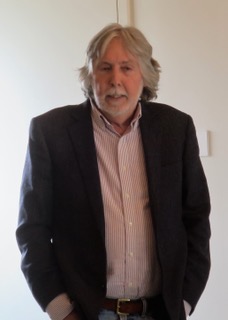
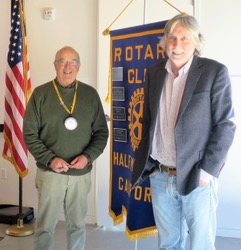
DANA LYNCH
Optical Physicist at NASA Ames Research Center
Article by Stacy Trevenon
Photos by EJ Dieterle
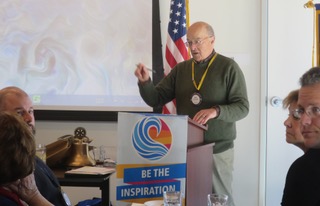
Today's speaker was Montara resident Dana Lynch, recounting his experience as an optical physicist at NASA Ames Research Center from 1986 until retiring as of June 30, 2016. He had earned his bachelor's degree in Chinese Studies in 1977 from Yale College and a master of science degree in physics in 1985 from San Francisco State University.
He passed out copies of his curriculum vitae, beginning with his general roles and areas of work at NASA which were in design, analysis, development, and testing of physical systems. His major field of work was in optics, with minor fields of work in diffusion modeling, digital mechanics and thermal modeling. He had secured three patents and one Ames Honor Award.
His curriculum vitae listed, as major projects and roles from 1986 to 2016, design and construction of two laser velocimeters for wind tunnels at Ames, two airborne absorption spectrometers, one airborne photometer, two airborne spectrometers, wire integrity research and a lunar impactor satellite payload. He spoke at length about these projects and roles, in an informal and comfortable way that made the projects and the work that went into them clear and interesting and made the listeners understand why the projects were undertaken and what the importance of them was.
He also infused his talk with humor and photographs of and references to his family, especially his daughter, when he took her as a young child to work with him. He shared how, at age 7, she told him she was lucky to have a father who worked on such interesting things, and he hoped we listeners felt that way in our lives and work too.
When he was finishing his master's degree in 1985, he mentioned to his San Francisco State department chair that if anyone came looking to hire a physicist, they should point that person to him. "Optics weren't necessarily on my mind," he said later. "It just turned out that way." The rest was history.
He told of finishing the laser velocimeters in 1986-7 and their importance in measuring wind speed, a vital factor when it comes to the space shuttle. He spoke of optics versus electronics and illustrated what he was saying with colorful photos of the optics. From 1987 to 1990, working with the laser velocimeters, he helped construct the means to feed light into very tiny -- hair-thin -- optical fibers and described the very shaky wind-tunnel environment he worked with. Around 1990, they briefly held the world record for transmitting high-power coherent light through optical fibers. At the meeting he did not get into the details of what coherent light is, as opposed to what we all usually see.
From 1991 to 1995 he was working with the "Argus," (a name with Greek roots. a name given to the airborne absorption spectrometer that they built.) on equipment designed to measure gases in the atmosphere. He also worked with part of the Argus known as a Herriott cell, which he said is "used to create a long path-length in a small volume -- one of a variety of 'multipass absorption cells' or cells in which the light passes multiple times in order to increase the absorption effect." He worked on creating the "Crown of Thorns," an informal name given by a colleague to the multipass absorption cell that they created for another instrument, which ultimately was not built.
Moving to 2000 to 2005, he spoke of Eileen Collins, the first woman shuttle commander, and a situation with the shuttle. After the July 1999 launch of STS-93 (the first shuttle commanded by a woman) it experienced a shorted wire only a few seconds into the launch. The incident of this short brought NASA into ongoing research by owners of large, aging aircraft such as those used by airlines and the military, and wire integrity research followed.
During his involvement with wire integrity research, coincidentally on Sept. 11, 2001, he and colleagues were at an Orlando conference on aging aircraft.
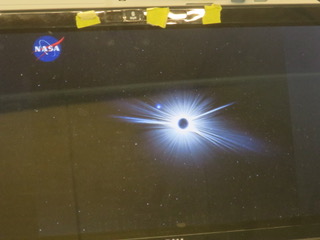
He showed a 2002 photo of his daughter fresh from Space Camp, clad in her camp jumpsuit. He also spoke of a project that involved taking a payload to crash on the surface of the moon, studying the plume of dust, perhaps 4 miles high, that would be raised by the crash. That procedure helped in seeking evidence of water on the moon's surface. He spoke of how some involved with the projects wanted to etch their own or immediate family members' names on plates on the spacecraft, so they could tell their children how their names would be on the moon. To forestall that, project managers had the craft's aluminum plates machine-etched with the names of the immediate family members. He showed an artist's rendition of the payload approaching and impacting on the surface of the moon, and finished that section of his talk by describing craft he wanted to send to the moon to check on such an impact.
His last big project, from 2014 until 2016, involved testing the thermal tiles on the shuttle, to gauge whether they could survive the heat of re-entry. But since we no longer fly the shuttle, new heat-shield materials will be used on future spacecraft such as Orion.
Training was part of his 30-year NASA career too. He traveled to an Air Force reserve facility in Albuquerque to train others who had bachelor's degrees in physics to work with optics. He spoke of concerns lest light penetrates shipping materials such as thick graphite blocks. "Turns out there are different types of graphite," he noted.
He described the enthusiastic response by young physicists to the dramatic destruction of test graphite and steel samples. "You start blowing things up and young men get excited," he said wryly, but he also pointed out that researchers do not regularly blow things up, but only do so in the quest to find something that would not be destroyed.
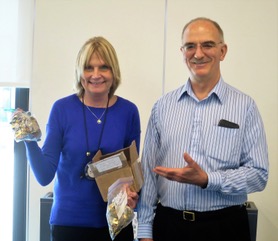
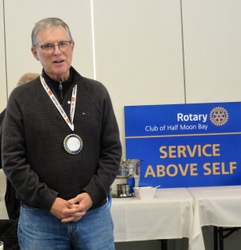
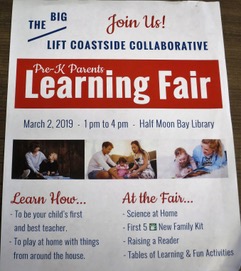
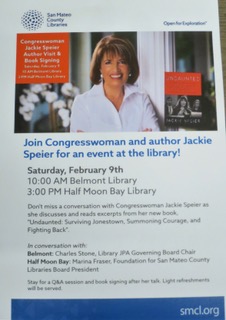
FEBRUARY 7, 2019 CLUB MEETING (Editor's Note: I have not received anything from the assigned writer for this week's meeting, so all you will find are the pictures. If/when the article is received, it will be added.)
Article by
Photos by EJ Dieterle
Greeters:
Pledge of Allegiance:
Inspirational Thought:
Guests and Visitors:
 Happy News
Announcements
REMINDERS
Our Monthly Rotary Day at the Community Free Breakfast (held at the Lutheran Church will be Wednesday, FEBRUARY 27. Please sign up with ROSE SERDY for a shift for future days (last Wednesday of each month.)
PHOTO GALLERY