________________________________________________________________________________________________
The FOGHORN
ROTARY CLUB OF HALF MOON BAY
Annual Joint Meeting of Rotary Clubs of Half Moon Bay, Pacifica and Millbrae
January 11, 2022
Speaker - The Honorable Jackie Speier
U.S. House of Representatives
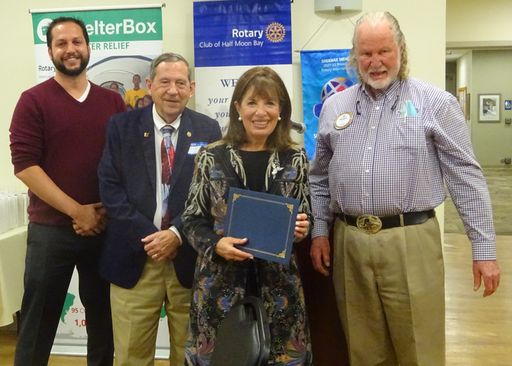
Article by Stacy Trevenon
Photos by EJ Dieterle and Liz Schuck
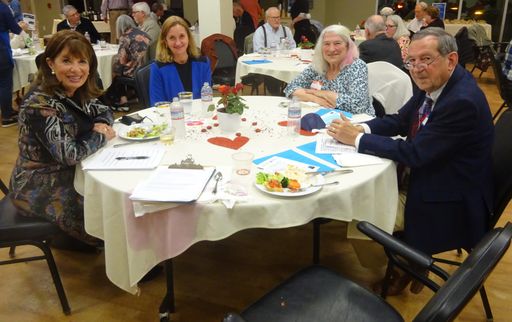
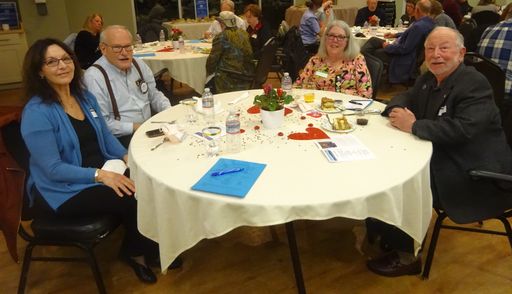
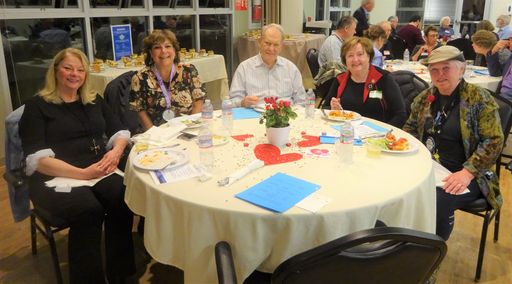
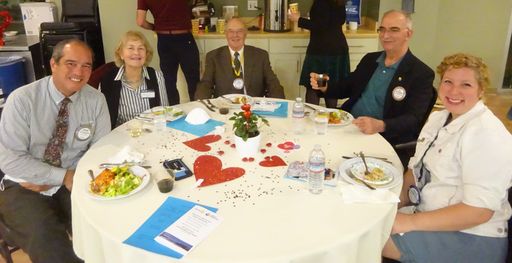
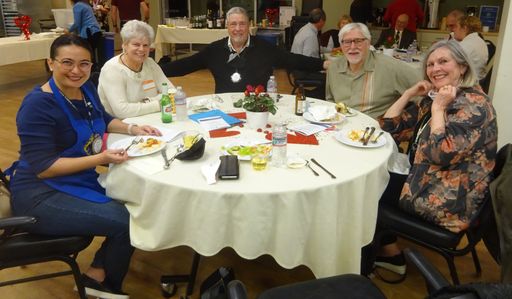
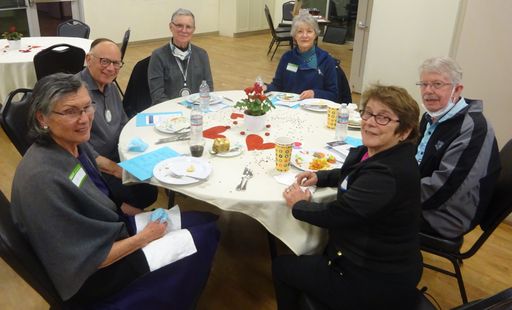
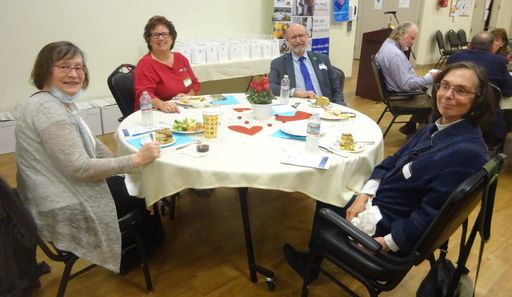
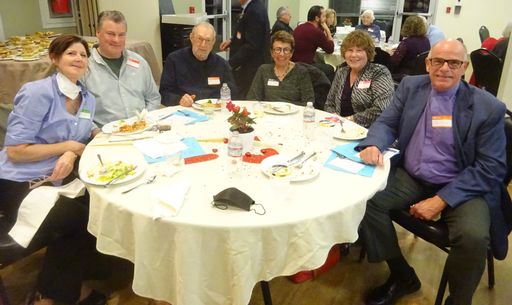
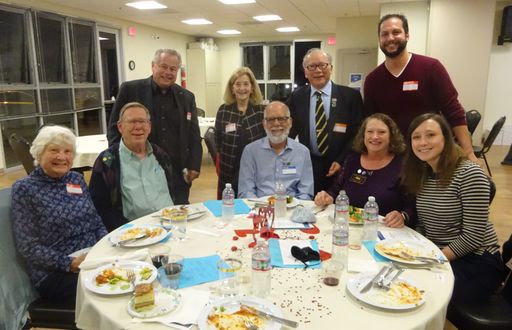
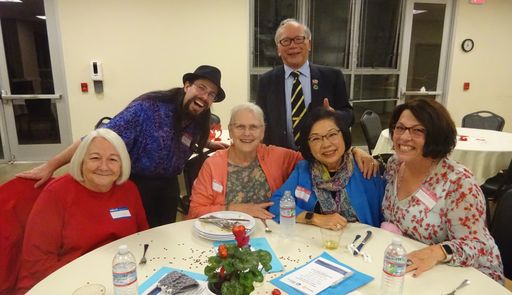
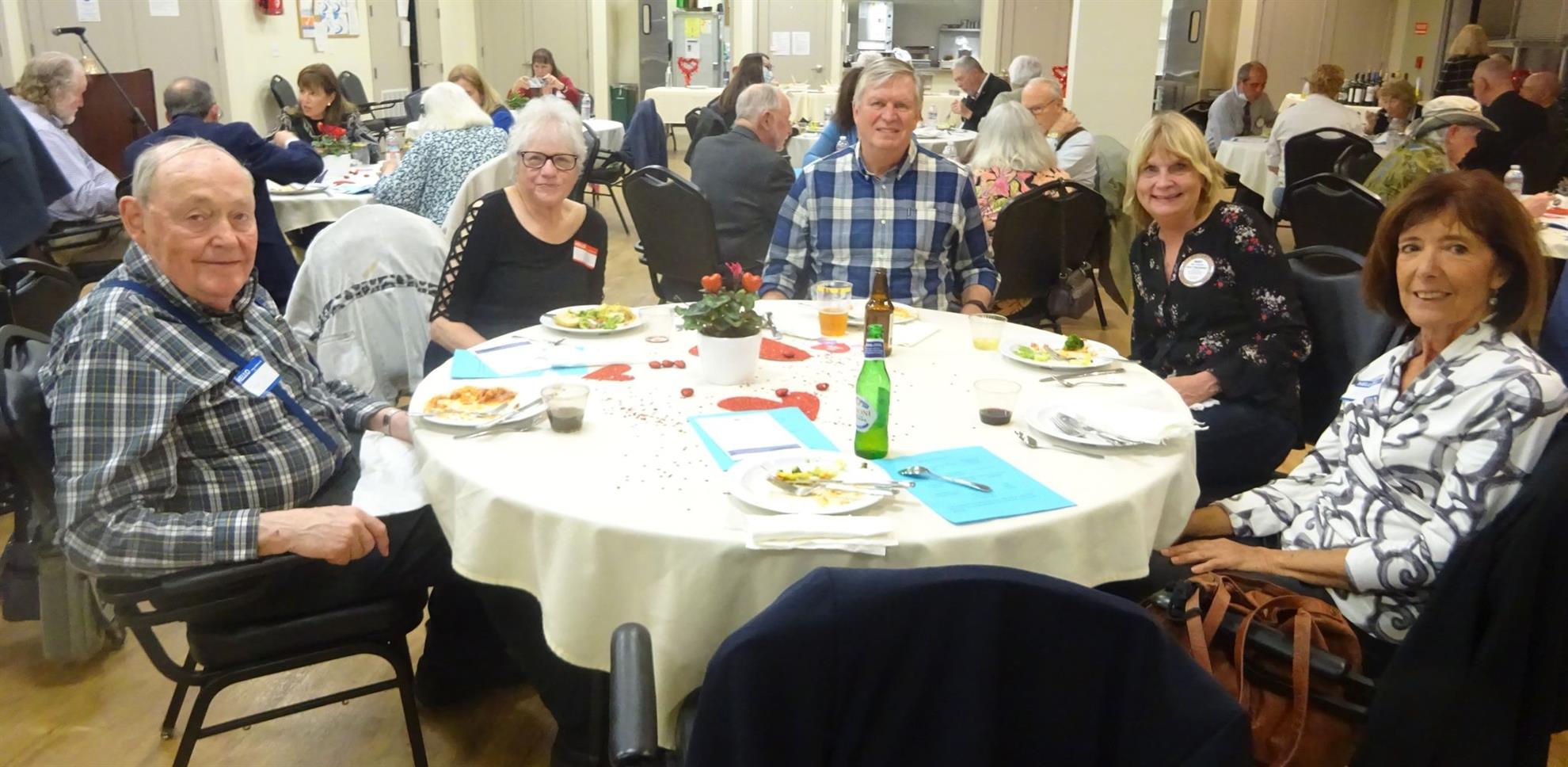
The joint meeting was hosted by the Rotary Club of Half Moon Bay and held in the Half Moon Bay Senior Center, where 14 tables were set up with 4 to 5 chairs around each. The tables were decorated with centerpieces of sparkling red hearts, little red-wrapped chocolate hearts, matching little red dots, and red flowers with little red hearts.
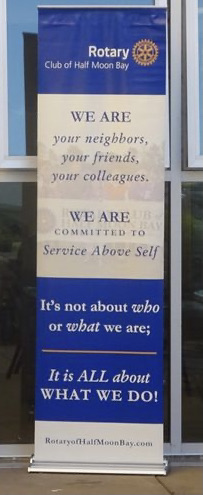
EJ and Rose Dieterle greeted guests, and took names and vaccination status. A big poster commemorating Shelter Box hung in the back of the room. Near the podium was our Club Banner with our identifying statement: "It's not about who or what we are; It's ALL about WHAT WE DO."
Volunteer bartenders Stacy Trevenon, Doug Mallon, Ralph Ely and Heather Bodmann served wine, beer and, bottled water, but the event was largely self-serve.
Rotary President Joe Brennan welcomed all around 6:30 in the evening, and PP and current District Chair of Membership Mitone Griffiths encouraged all to get food which was set out buffet-style.
Other guests present who were introduced included Rotarians Rick Chinn of the Millbrae Club and Steve Wright from the Pacifica Club, both playfully but also realistically introduced as “men of many titles" having taken on many Club and District-level leadership roles. Also introduced were Assistant District Governor Shari Teresi and District Governor Danielle Lallement. The three presidents of the three participating clubs were recognized – Joe Brennan, Half Moon Bay; Philip Petro, Millbrae; and Patrick Hall, Pacifica.
Patrick Hall was invited up to introduce the evening’s speaker, The Honorable Jackie Speier, representing California’s 14th Congressional District, an invitation he happily accepted. He set an informal and comfortable tone for the evening when he reminisced about his relationship with Jackie, noting that they had attended law school together. He pointed out that she had often spoken in her heartwarming way for Rotary meetings and events.
Programs handed out before the meeting included more information about Speier, beginning with the assertion that she “is a fearless fighter for women’s quality, LGBTQ rights and the disenfranchised,” … and has been named to Newsweek’s list of 150 “Fearless Women” in the world and “Politico’s 50” most influential people in American politics for bringing the "Me Too" movement to Congress. Her congressional region stretches from southern San Francisco through San Mateo County to East Palo Alto. She serves on the House Armed Services Committee and on the House Permanent Select Committee on Intelligence, and more. She also serves on the House Committee on Oversight and Reform, and is also co-chair of the Democratic Women’s Caucus, the Congressional Armenian Caucus, the Bipartisan Task Force to End Sexual Violence and the Gun Violence Prevention Task Force. And that’s only a partial list.
She first ran for Congress in 1979 in a special election for the seat formerly held by Congressman Leo J. Ryan, for whom she had served as a legislative aide before he was infamously shot to death in Jonestown in Guyana at the People’s Temple cult. She herself was shot five times at point-blank range with an assault rifle and left nearly lifeless on the airport tarmac, recuperating only after multiple surgeries. During her recuperation, she faced a choice between being a victim or a survivor, choosing the latter and noting that “looking death in the face can make you fearless.”
Jackie then took the podium amidst enthusiastic applause, and gave a talk that riveted all listeners.
(Click on "Read more for the rest of the speech and the meeting).
Here is a copy of her planned talk:
I was asked to give a current events update and then to offer some reflections and then to take questions. Let me follow the script and I’ll try to make this quick.
Issue #1- Russia/Ukraine
Issue #2 – Pandemic
She touched on the current situation with Putin and Ukraine and that this year being the 100th anniversary of the Russian revolution, Putin wants to secure his legacy. She spoke of the cost of the conflict there on all sides and of high casualties – 50 to 100,000 could die; “it takes your breath away,” she said. She spoke of Putin as “a man who will stop at nothing"; touched on NATO and what the president could do.
She also brought the talk closer to home, updating on the three clubs represented at the event, noting that the current situation – trying to function in a world beset by covid, and the situation of having to wear masks being a first priority for us and our families – is a sad one. She spoke of our club and the forgiveness of loans that were given in the government covid relief bills through her district. And she spoke of businesses that Rotary has helped to stay afloat and the people it has supported, in this time of Covid 19.
She then continued:
Let me talk for a moment about the vital importance of Paycheck Protection loans during 2020 and 2021. Here are just four local examples out of hundreds of businesses that were helped by these forgivable loans to small and medium-sized business:
A Bakery in Half Moon Bay received $161,600. Forgiven
A restaurant here in Half Moon Bay received $332,500. Forgiven.
A tow truck company in one of our cities received $37,850. Forgiven.
Good news for those of you who make it a habit to park in red zones—the tow truck company is still in business!
A local pre-school in Millbrae received $64,365. Forgiven.
When times were tough, the tough needed a loan. The federal government stepped up. All this talk about how the federal government is spending too much? 16,000 grants worth $5.7 billion went to restaurants. 692,000 loans worth $35.9 billion went to California businesses. What those folks are really saying that they don’t want to support jobs. They don’t want to support small and medium-sized businesses. That’s where quite a lot of money went—that and healthcare. Frankly folks, during an emergency, that’s what this spending boils down to—supporting jobs, businesses and health.
Sticking to my script, I was asked to talk about my legislative priorities.
- Sexual Assault in the Military
- Suicides in the Military
- Reducing costs
- Infrastructure projects in the Bay Area worth $4.5 billion
- Build Back Better – child care, universal pre-K
Ok, so I know there will be plenty of questions at the end so let me now turn to some reflections. And let me begin by noting that I started in elective office in 1980 and San Mateo County was in many ways quite different than it is now.
So now let me share some reflections with you after serving in public office in San Mateo County, for 39 out of the past 42 years. The first observation is that we forget all that has changed in that time. Let me use Half Moon Bay, Pacifica and Millbrae as my starting points:
The population in Pacifica was 36, 866 in 1980. Per census numbers, it was 37,640 in 2020. The median household income in 1980 was $24,175. Adjusted to inflation that would be $75,910 now, but the median income in Pacifica is $125,500.
The population in Half Moon Bay was 7,282 in 1980. In 2020 it went up to 11,795 . The median household income in 1980 was $25,467. Adjusted to inflation that would be $79,966 now, but the median income in Half Moon Bay is $134,177.
The population in Millbrae was 20,058 in 1980. In 2020 it went up to 23,216. The median household income in 1980 was $26,209. Adjusted to inflation that would be $82,296 now, but the median income in Millbrae is $128,494.
Looking at those numbers we could say we are doing pretty well. In each city, median household income grew far more than it would have if it only tracked inflation. There are towns in farming communities throughout this country where population is falling. Not here on the Peninsula. It’s gone up.
Then we look at the housing prices. The median home price in San Mateo County today is $1.3 million. In 1980, it was about $200,000. Adjusted for inflation, that would be $628,000 today. But it’s $1.3 million, more than twice as much.
Let me point out an observation of the nonprofit group Sustainable San Mateo, which produces an “Indicators” report every few years for our county. And here’s where the rubber meets the road:
“Between 2010 and 2019, 102,500 new jobs were created in San Mateo County, while only 9,494 new housing units were built, a[n] 11:1 ratio. Generally, San Mateo County has not produced as much housing as other inner Bay Area Counties.”
And they continue:
- There are approximately 330 large land development projects either approved, under review or under construction in San Mateo County.
- These projects represent approximately 40 million square feet of net new construction. To provide some perspective, that number is more than 12 times the size of the Facebook campus in Menlo Park.
- If all the projects are constructed, they will create more than 106,000 new jobs in San Mateo County, probably in the next five years, but there will be fewer than 25,000 new housing units produced. That would mean a new jobs to new housing ratio of 4.24 to 1.
- It should be noted that the Association of Bay Area Governments (ABAG) and the Metropolitan Transportation Commission (MTC) have projected that the number of jobs in San Mateo County will grow to 506,000 by the year 2050. However, if all the projects currently in the pipeline are completed in five years, resulting in 106,000 new
jobs, the actual number of jobs in San Mateo County will be 537,000 in 2027, 23 years sooner that what is projected by ABAG/MTC.
Members of Rotary, I submit that what is happening in San Mateo County is not just. We talk a lot today about income inequality. I submit that San Mateo County is growing itself into a level of income inequality that is shocking to the conscience. Nearly everyone in this room is a homeowner and we are getting rich just by sitting still. Many of our fellow residents—those who are renters—are being driven to the point where they face extreme hardship. And it’s not enough that we try to build more housing—which we must. We should also reconsider whether we can afford to remake the Peninsula with so many additional jobs.
Let me make an observation about democracy—it is fragile. Soon, the people of Ukraine may be engaged in hand-to-hand combat to protect their independent and democratic nation. The people of Afghanistan who wanted democracy—and millions did— lost it. And of course, on January 6th, a few changes in the way things unfolded - a few more guns and a compliant vice president - and I believe that Donald Trump would have been declared President of the United States for a second term. As the Select Committee is discovering, there was a plan to replace a legitimate election with a fraudulent outcome. So, democracy is precious, and fragile.
She then took the audience through her personal experience on January 6 in the House of Representatives gallery. She told the details of what was happening, the steps they were directed to take, and of lying with her face pressed to the floor listening to the banging on the doors as the insurrectionists tried to break in and the Capitol Security with guns drawn to defend the people inside. She said that for the first time she truly thought she was going to die after living through Gayana and now to die in the Citadel of Democracy was unfathomable. (It was a very emotional moment for all of us listening to her.)
She continued:
One of the biggest dangers to democracy is when people lose hope that they can prosper. My generation was the generation that followed the president’s words: “Ask not what your country can do for you, ask what you can do for your country.” Well, today’s generation of young people in San Mateo County—those without college degrees and many with degrees that do not fit our local economy—they justifiably ask, “What can anyone do so that I can survive?” I don’t have a perfect answer for that question, but it begins by asking whether we can afford all these jobs or whether a lot of that land needs to be set aside for housing instead of laboratories and offices.
Let me reflect upon three levels of government. After serving at all levels of government, I believe that local government is the most effective. State government is the most flexible, and the federal government is potentially the most powerful.
Local government is effective because people complain about the potholes or a big tree that needs to be preserved, and someone acts. The state government is the most flexible because it is still physically very close to the people that it serves, because the people it serves are still somewhat similar, and because California’s government has quite a bit of money to create quality services for our population.
Then we get to the national government…. What struck me immediately after joining Congress was the reality that compromise was a huge part of getting things done. But compromise is a dirty word. We stall. We pass CRs and not a budget.
The federal government is potentially the most powerful because if Congress and the President are capable of compromise then the financial resources of our national government are enormous. The authority under our constitution is enormous. The national government can also borrow and spend billions in near record time so that a restaurant on Main Street in Half Moon Bay survives a 100-year pandemic. That’s how powerful we are if we compromise.
Serving you has been the greatest privilege of my life. Let me end by sharing some special moments during my time in Congress with you.
- Easter egg hunt in Statuary Hall
- HMB Farm Day, raise money for Coastside Hope for powdered milk
- Waiting for votes while the minority leader gave longest floor speech to break the speaker record, drinking wine and eating chocolate with chief of staff – glamorous work!She spoke of her top priorities, in her position, and her work aiding sex workers and victims of assault and sexual harassment, also harassment and suicides in the military, and on early deployments, which is something she has worked on in recent years, up to the past decade.
- She meets with families of victims.
Touching on other concerns, she said she is planning to work with and include women who are out of work, and child care, and this in the time of Covid. She pointed out that elsewhere in the world there are programs in place that address concerns like these or women who have left the work force. She reflected on her own 39 years in office, having become involved in politics in 1980. She looked at the economic differences then versus today, and at new jobs in San Mateo County versus other Bay Area counties.
She made it clear that in her view, we have work to do. She invited us to look at the income inequality in the county, and pointed out that we have wealth and comfort. She touched on the words of Ben Franklin about asking what you can do for your country, and mentioned the fleeting nature of democracy, citing her own experiences seeing people getting to the third floor of the Capitol on Jan. 6. “When people say it’s fragile, believe them,” she said. We are fortunate to live in goodness and comfort and positive things like Rotary. We have an obligation to embrace democracy, and she encouraged us to question what we are told, what they say on TV.
She spoke of how Congress tries to gets things done, but with the filibuster in its present form … she remarked on how it took the court system to pass LGBT rights, and encouraged listeners to think of the decisions that had been made.
She shared special memories of very human moments she experienced on the Coastside and other places: She cited an Easter egg hunt in Statuary Hall, a Farm Day in Half Moon Bay in which money was raised for Coastside Hope which went toward the purchase of needed powedered milk, and one which drew laughter from those present: she was awaiting a vote count while the minority leader was giving a long floor speech, aiming to break the speaker record, sipping wine and eating chocolates with the chief of staff, which she described as “glamourous work” – indeed!
She announced that she would take questions. Those started with a question about the Build Back Better Movement.
Would she change two-year terms? She did not think so. She listed some changes in population and in median household incomes for Pacifica and Half Moon Bay. After answering many more questions, she ended. President Joe Brennan presented her with a certificate that indicated that a donation to the Rotary International "End Polio Now" campaign for 43 children to be vaccinated would be made in honor of her 43 years of government service in both California and the U.S. House. She mentioned that it was 39 years at this point, so Joe said the extras would be a bonus.
___________________________________________________________________________________________
Club Activities Announcements
Joint Club Annual Donation to Shelter Box - PP and current District 5150 Membership Chair Mitone Griffiths gave a brief overview of the Shelter Box Project started by Rotary and the tremendous number of people all over the world that have been helped in times of major disasters. She also covered the history of the 3 Club's commitment to support it. Each year starting in 2014, then under the leadership of Club Presidents Dianne Bobko (HMB), Linda Jonas (Pacifica) and Carrie Chinn (Millbrae), the 3 Clubs have donated $1000 to Shelter Box at this event. Mitone ended with a challenge to the 3 Clubs to increase that donation.
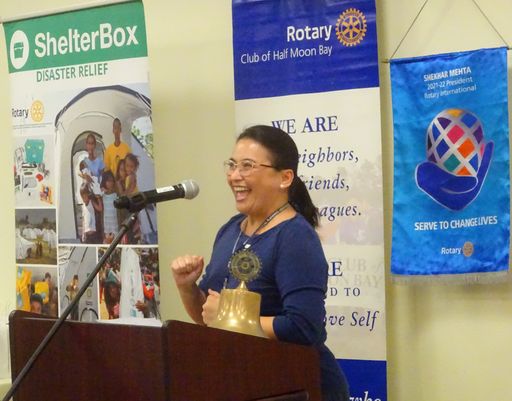
Paul Harris Fellow Recognition - 5150 District Governor Danielle Lallement talked briefly about about Paul Harris the founder of Rotary International and the awards members receive based on the amount of money they donate over the years: Heather Bodmann received a Paul Harris award plus 1, and Joe Brennan received a Paul Harris plus 5. (A Paul Harris award is given when a member donates a total of $1000 and then each subsequent $1000 donation adds another level. of recognition.)
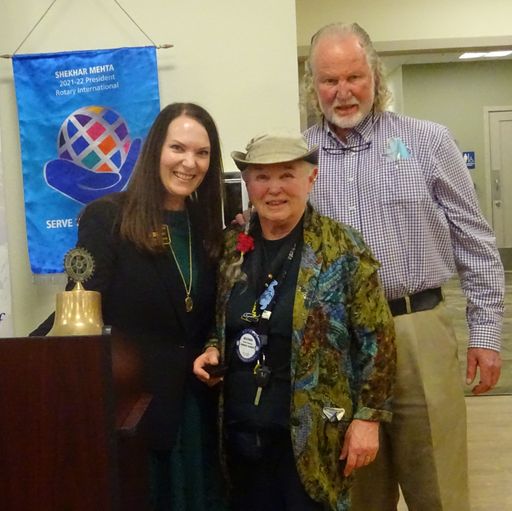
After this President Hall of Pacifica asked Pres. Joe Brennan to announced that for this year, as a special add on, our joint Shelter Box donation would honor Representative Jackie Speier.
PHOTO GALLERY